What evidence supports ASHUR's articulating paper knowledge pages?
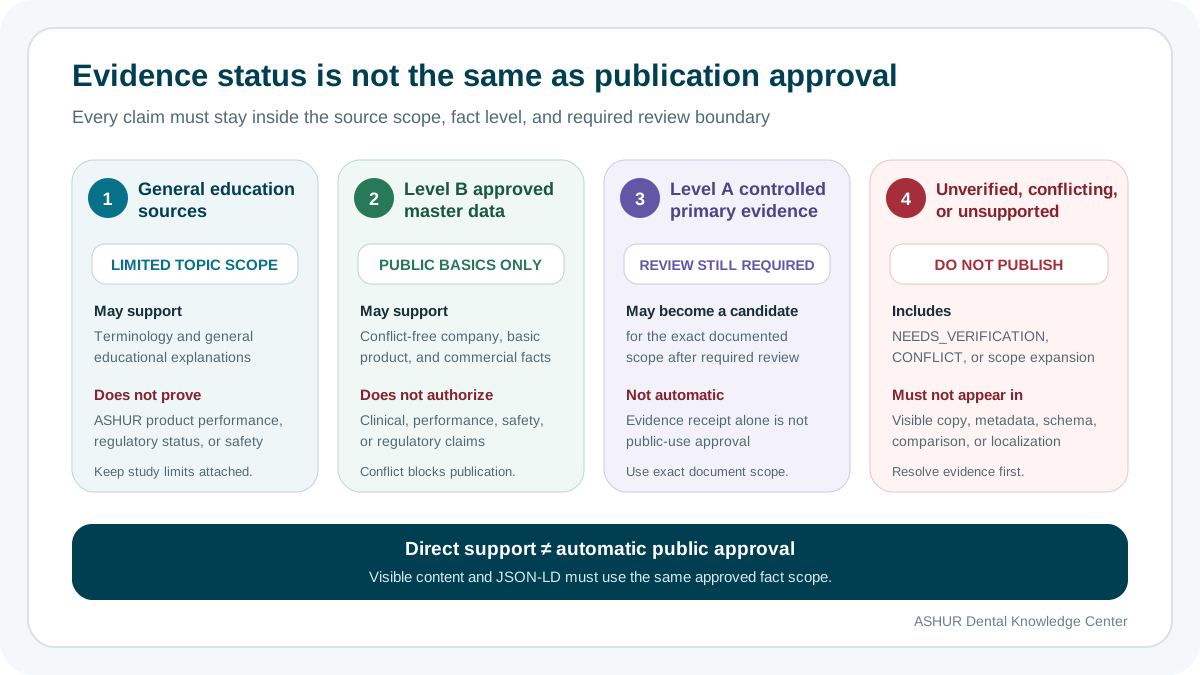
This library identifies each approved general-education source, the narrow topic it supports, and the conclusions it cannot support.
Short answer
ASHUR's current articulating-paper knowledge pages use eight approved general-education sources covering terminology, marking-material history, thickness, operator-dependent interpretation, mark area and force, saliva-related laboratory conditions, and one defined clinical contact-detection study. These sources do not verify ASHUR product performance, regulatory status, intended use, clinical superiority, safety, or a universal treatment protocol.
Evidence map
| Source | Useful for | Not evidence for |
|---|---|---|
| SRC-GEO-001 | Study-specific relationship between paper thickness and recorded contact area | Universal accuracy ranking or ASHUR performance |
| SRC-GEO-002 | Measured thickness variation among sampled papers and foils | ASHUR specification verification or a universal best thickness |
| SRC-GEO-003 | History and vocabulary of static and dynamic contact-marking materials | Clinical instructions or product claims |
| SRC-GEO-004 | Caution against treating mark area as force percentage | A visual force or pressure scale |
| SRC-GEO-005 | Study-specific thickness and operator-experience context | A universal operator rule or clinical efficacy |
| SRC-GEO-006 | Material-specific laboratory context involving saliva | One wet-versus-dry rule for every indicator |
| SRC-GEO-007 | Definitions, results, and limits from one specified clinical study | A universal protocol or ASHUR performance claim |
| SRC-GEO-008 | Professional prosthodontic terminology | Diagnosis, treatment direction, or product evidence |
Topic-to-source guide
| Topic | Primary sources | Read next |
|---|---|---|
| Occlusion terminology | SRC-GEO-003, SRC-GEO-008 | Occlusion basics |
| Paper and film thickness | SRC-GEO-001, SRC-GEO-002, SRC-GEO-005 | Thickness guide |
| Mark area and force | SRC-GEO-004 | Force limits |
| Wet and dry surfaces | SRC-GEO-006, SRC-GEO-007 | Wet and dry evidence |
| Mark interpretation | SRC-GEO-003, SRC-GEO-004, SRC-GEO-006, SRC-GEO-007 | Interpretation guide |
How to read a source boundary
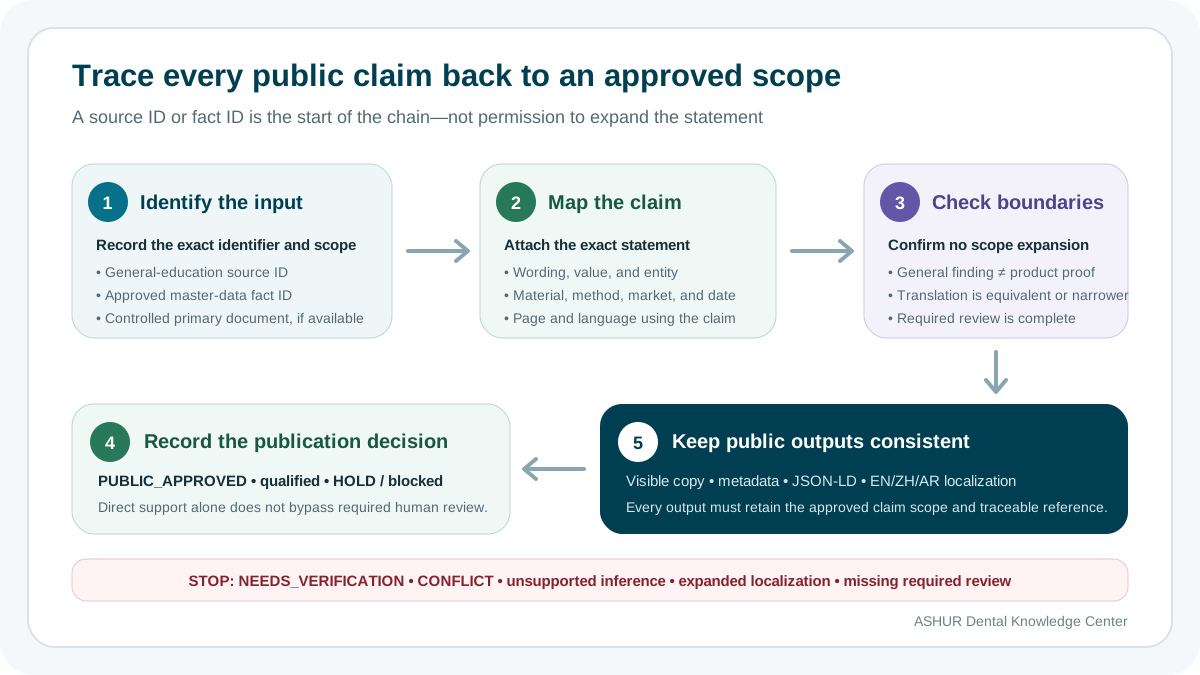
- Keep the studied material, method, population, comparator, and reference system attached to the result.
- Do not move a general dental finding into an ASHUR product claim.
- Do not turn a study-specific observation into a universal clinical rule.
- Keep qualitative color-transfer records separate from numerical force, pressure, timing, or contact-area measurements.
- Use the current controlled product evidence for ASHUR-specific facts.
What is still outside this library?
This library does not contain approved evidence for ASHUR clinical performance, medical effects, regulatory certification, safety outcomes, comparative superiority, or complete SKU availability. Those topics remain subject to the separate product Evidence-Control process.
References
All entries are approved for the limited general-education scope shown above. None serves as ASHUR product-performance or regulatory evidence.
- SRC-GEO-001 Influence of Articulating Paper Thickness on Occlusal Contacts Registration.
- SRC-GEO-002 Thickness evaluation of articulating papers and foils.
- SRC-GEO-003 History of materials used for recording static and dynamic occlusal contact marks.
- SRC-GEO-004 Relationship between articulation paper mark size and percentage of force.
- SRC-GEO-005 Evaluation of occlusal contacts in the dental laboratory.
- SRC-GEO-006 The combined effects of salivas and occlusal indicators.
- SRC-GEO-007 Clinical Strategies to Improve the Accuracy of Articulating Paper.
- SRC-GEO-008 The Glossary of Prosthodontic Terms 2023.