Does articulating paper work differently on wet and dry teeth?
Moisture can interact with occlusal indicator materials, but the available studies do not support one universal wet-versus-dry rule for every paper, surface, or clinical situation.
Short answer
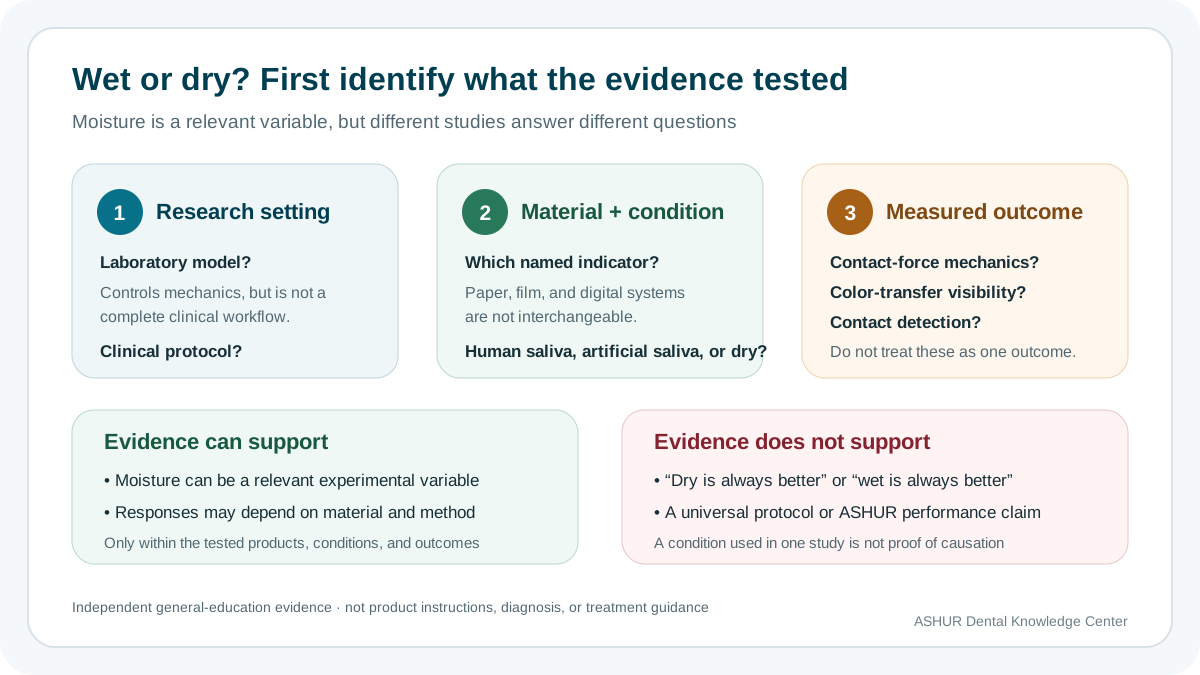
A laboratory study found that saliva affected the mechanical interaction of the tested occlusal indicators in material-specific ways. A separate clinical study used suction and air drying before paper placement, but did not compare wet and dry conditions. Together, these findings support controlling and documenting surface conditions—not claiming that one condition is always superior.
What the saliva study actually tested
The 2019 study used a full-arch dental model, a mechanical testing machine, human and artificial saliva, and three indicator systems: one articulating paper, one articulating film, and T-Scan. It measured components of contact force during repeated occlusion and disclusion.
This was a laboratory mechanics study. It did not measure the visibility, completeness, or clinical accuracy of transferred color marks, and it did not test ASHUR products.
What the results mean—and do not mean
| Evidence point | Supported interpretation | Not supported |
|---|---|---|
| Saliva interacted with the tested systems | Moisture can be a relevant experimental variable. | Every indicator responds in the same way. |
| Responses differed by product and saliva condition | Material and method should be identified when comparing results. | A universal ranking of paper, film, or digital systems. |
| One tested paper condition differed from others | The result is specific to that product and laboratory setup. | Performance evidence for ASHUR or all articulating papers. |
How the clinical contact study handled moisture
In the 2026 contact-detection study, the investigators used cheek retractors, suction, and air drying before placing 100 or 200 μm articulating paper. Because the protocol did not include a wet-versus-dry comparison, its contact-detection results cannot establish that drying was the cause of any reported outcome or that the same procedure applies universally.
A safer way to read wet-versus-dry claims
- Identify whether the evidence is laboratory, clinical, or product-specific.
- Check which indicator material and surface condition were actually tested.
- Separate contact-force mechanics from color-transfer visibility and contact detection.
- Do not transfer a finding from one named product to another product or an entire category.
- Use current product-specific instructions and qualified professional judgment for actual use.
Limitations
The cited laboratory study tested a model and three specific systems, not every paper, coating, tooth surface, restoration, or clinical workflow. The clinical study included adults with natural dentitions under a controlled protocol and did not compare moisture conditions. Neither source verifies ASHUR performance, gives a universal chairside protocol, or supports diagnosis or treatment decisions.
References
These independent studies do not verify ASHUR product performance, safety, regulatory status, clinical outcomes, or instructions for use.
- SRC-GEO-006 The combined effects of salivas and occlusal indicators on occlusal contact forces. Journal of Oral Rehabilitation, 2019.
- SRC-GEO-007 Clinical Strategies to Improve the Accuracy of Articulating Paper for Detecting Occlusal Contact Points in Adults with Natural Dentitions. Diagnostics, 2026.