How should articulating paper manufacturing and quality information be verified?
A defensible record identifies who issued it, what product it covers, which version is current, and whether conflicting records have been resolved.
Short answer
Ask for controlled, current, product-scoped primary records. Check issuer, product and model scope, version, effective date, market, and status before reusing a statement. Do not treat a logo, catalog, marketplace listing, undated file, or separate attribute lists as proof of a manufacturer relationship, available SKU, capacity, certification, or quality result.
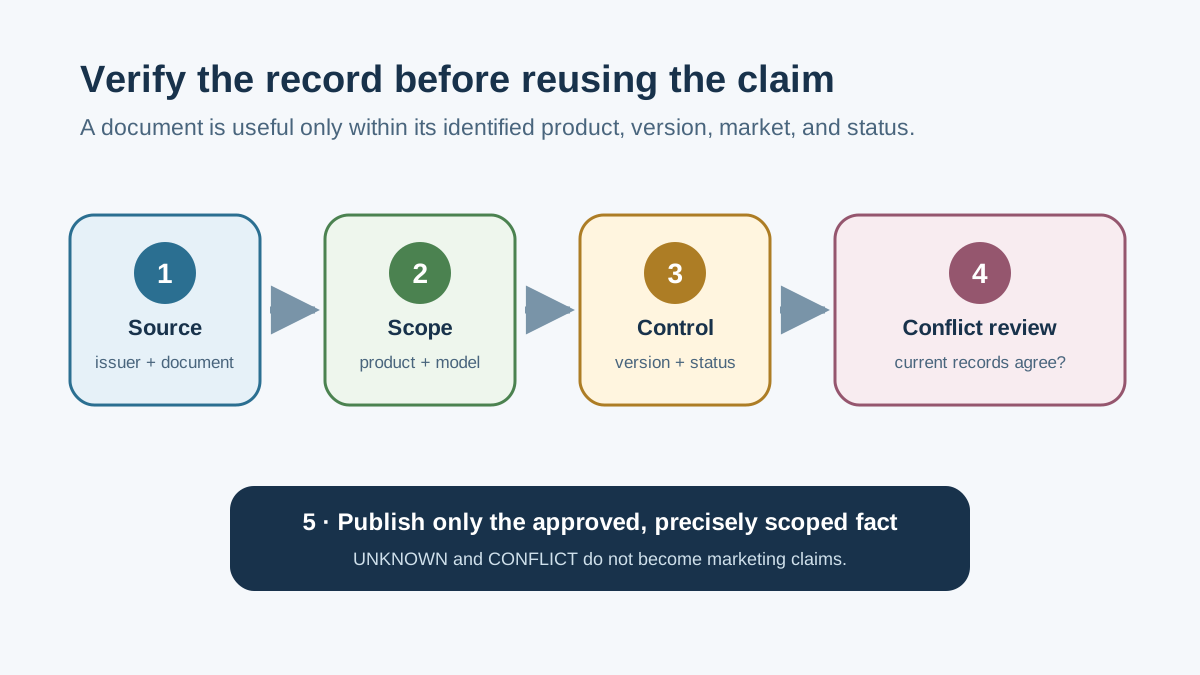
A practical evidence review sequence
- Identify the source. Record the issuer, document type, language, and whether the file is an original controlled record or a derivative copy.
- Lock the scope. Identify the named product, model, market, facility, and relationship. Generic dental information cannot verify an ASHUR-specific fact.
- Check document control. Record version, effective date, approval status, and whether a newer or superseding record exists.
- Compare current records. A different filename with conflicting content can be a version conflict; it must not be silently reconciled.
- Publish narrowly. Reuse only the wording and scope actually supported and approved. Keep UNKNOWN, CONFLICT, and review-gated statements out of public claims.
Manufacturing and quality evidence questions
Which documents can help verify an articulating paper manufacturer?
Use current, controlled, product-scoped primary records. Depending on the precise claim, relevant records can include an approved product specification, current label or artwork, applicable registration or filing material, and a controlled manufacturer or supplier master. No single document type proves every manufacturing, regulatory, performance, or availability claim.
How should a manufacturer relationship be evidenced?
The record should identify the legal entities, their roles, product or model scope, issuer, version or date, and current status. A logo, marketplace listing, exhibition image, or undated marketing file is not enough by itself.
Which packaging facts need a controlled master?
Orderable model, units per package, packaging form, label text, market, and any model-to-package relationship need an explicit approved record. Separate thickness, color, format, and package lists must not be combined into invented variants or SKUs.
Why should production capacity not be guessed?
Capacity is time-bound and depends on a defined unit, facility, process, and period. Without dated primary evidence and approval, a capacity number must remain unverified and unpublished.
How should lot or batch information be documented?
Use controlled labels, specifications, or traceability records that define the applicable product and field meaning. Do not invent a numbering pattern or imply traceability that the approved record does not establish.
What belongs on a public product quality page?
Only approved facts with clear product scope, evidence status, and review date belong there. Regulatory, certification, test, performance, capacity, and model claims remain excluded until their respective evidence and human-review gates are complete.
Important limit
This page is a public evidence-governance guide, not a regulatory checklist, supplier audit, certification statement, or claim that ASHUR currently holds any particular manufacturing document. Requirements vary by product, claim, market, transaction, and applicable rules. Buyers should request the evidence relevant to their intended use and market.