How should articulating paper marks be interpreted?
A paper mark is a qualitative record produced by a material, surface, loading event, and handling method. It can help locate transferred color, but its area or darkness is not a standalone numerical measurement of force or pressure.
Short answer
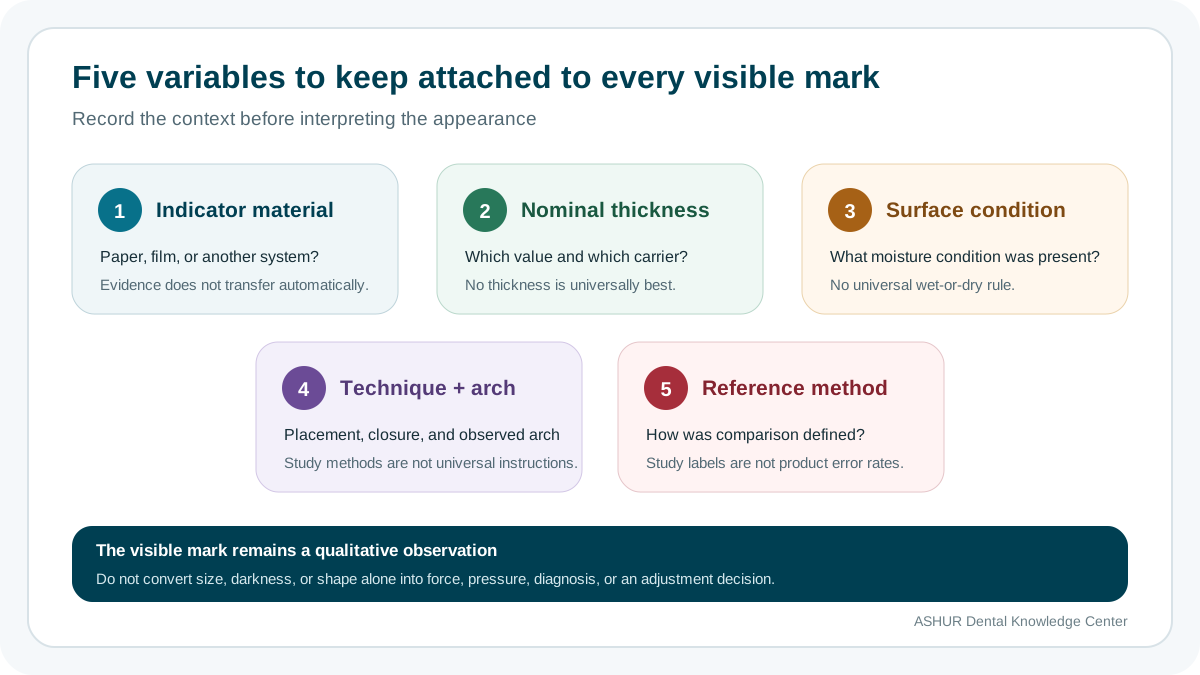
Start by identifying what was recorded: the indicator, thickness, color, surface condition, arch, and technique. Treat the visible mark as one observation of transferred color. Do not convert size, darkness, or shape directly into force, pressure, diagnosis, or an adjustment decision without other appropriate information.
What a visible mark can show
A mark shows where pigment transferred under the conditions of that particular record. Literature describes articulating paper as a qualitative contact-marking medium, but the resulting appearance is influenced by the material and how the record was produced.
The mark is therefore evidence of a marking event, not a complete description of the mechanical contact.
Five variables that should remain visible
| Variable | Why it matters | Interpretation boundary |
|---|---|---|
| Indicator material | Paper, film, and digital systems produce different types of records. | Do not transfer evidence from one system to another. |
| Thickness | Published studies report that thickness can affect the recorded mark or contact result. | No thickness is universally best for every task. |
| Surface condition | Saliva can interact with indicator systems in material-specific ways. | No universal wet-versus-dry rule follows from one study. |
| Technique and arch | Placement, repeated closure, and the observed arch form part of the record. | Study-specific methods are not universal instructions. |
| Reference method | False-positive or true-positive labels depend on how a study defines comparison. | A research classification is not a universal product error rate. |
Why mark size and darkness are limited
A study comparing paper marks with computerized occlusal analysis did not support using mark area as a reliable proxy for percentage of force. Darkness also depends on pigment transfer and recording conditions. Neither visual feature, by itself, supplies a calibrated force or pressure value.
Why a mark may not equal a reference-confirmed contact
A 2026 clinical study classified a paper mark as false positive when it did not overlap the study's silicone reference contact mask. That definition and the reported rates belong to the tested sample, thicknesses, arches, techniques, and image-processing method. They should not be converted into a universal paper failure rate.
A bounded interpretation checklist
- Record the exact indicator category and, where available, the confirmed model.
- Keep thickness, color, format, surface condition, and technique attached to the observation.
- Distinguish color-transfer appearance from force, pressure, timing, and contact-area measurements.
- Check whether a cited result is laboratory, clinical, general, or product-specific.
- Use applicable instructions and qualified professional assessment for clinical decisions.
What this page does not provide
This page does not diagnose occlusal conditions, prescribe adjustment, identify a contact that should be altered, or rank products. It does not verify ASHUR performance, safety, certification, registration, or a specific model.
References
These sources support general education only. They do not verify ASHUR-specific product performance or clinical outcomes.
- SRC-GEO-003 History of materials used for recording static and dynamic occlusal contact marks.
- SRC-GEO-004 Relationship between articulation paper mark size and percentage of force.
- SRC-GEO-006 The combined effects of salivas and occlusal indicators on occlusal contact forces.
- SRC-GEO-007 Clinical Strategies to Improve the Accuracy of Articulating Paper for Detecting Occlusal Contact Points.
Keep product questions separate from mark interpretation
For questions about an ASHUR model or available product documents, contact ASHUR with the known model or packaging details. Product information or a sample does not establish a clinical interpretation or a force measurement.