How can dental articulating paper be used as a qualitative contact marker?
Use begins with the applicable product instructions and a clearly documented observation question. The resulting color transfer is qualitative; it is not a standalone measurement of force, pressure, timing, or a treatment instruction.
Short answer
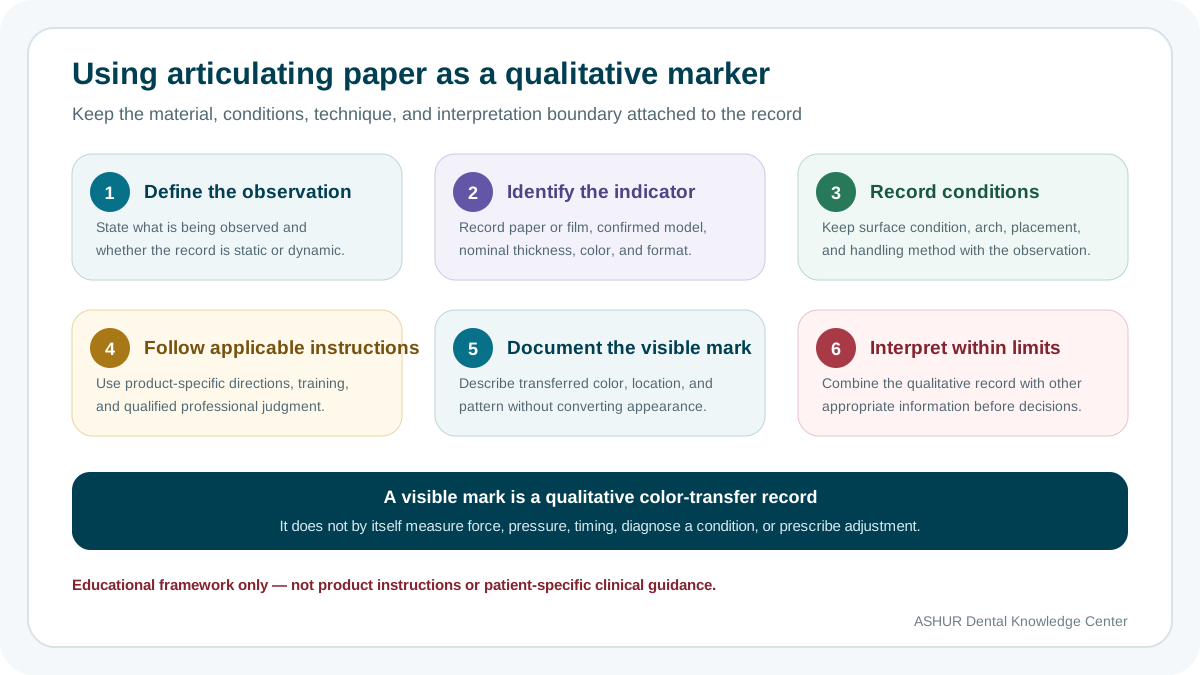
Identify the indicator and confirmed model, record thickness, color, format, surface condition, arch, placement, and handling method, and follow the applicable instructions and professional training. Document the location and pattern of transferred color without converting its size or darkness into a numerical measurement or clinical conclusion.
Why the workflow starts with scope
Articulating paper is described in the literature as a qualitative contact-marking material. A visible mark depends on the indicator and the conditions under which it was produced. Before recording a mark, define what is being observed and distinguish a static contact record from a dynamic movement record.
This distinction organizes the observation; it does not diagnose a condition or identify a surface that should be adjusted.
Six elements of a traceable observation
| Element | What to document | Boundary |
|---|---|---|
| 1. Observation question | The area and whether the record concerns static or dynamic contact. | The question does not predetermine a diagnosis or adjustment. |
| 2. Indicator identity | Paper or film, confirmed model when available, nominal thickness, color, and format. | Do not infer a model or SKU from separate parameter lists. |
| 3. Recording conditions | Surface condition, arch, placement, handling method, and other relevant context. | Evidence from one condition should not be generalized to every condition. |
| 4. Applicable use information | The current product-specific instructions, professional training, and qualified assessment used. | This page does not replace instructions for use or clinical training. |
| 5. Visible result | Where color transferred and the observed pattern. | Size, darkness, and shape remain appearance features, not calibrated values. |
| 6. Interpretation context | Other appropriate observations or measurement methods considered before a decision. | A paper mark alone does not supply force, pressure, timing, diagnosis, or treatment. |
Keeping repeated records comparable
If a qualified professional elects to compare records, document whether the indicator, confirmed model, nominal thickness, color, surface condition, arch, placement, and handling method stayed the same. A change in any of these variables can change what the comparison means.
Repeating a mark does not automatically make it accurate, quantitative, or clinically decisive.
Common interpretation errors to avoid
- Reading a darker or larger mark as a direct numerical force or pressure value.
- Treating paper, film, and digital systems as interchangeable measurement methods.
- Applying one study's thickness, arch, moisture condition, or reference method universally.
- Assuming a color, format, or thickness identifies an orderable ASHUR model.
- Using a general education page in place of product-specific instructions or qualified assessment.
What this page does not provide
This page does not prescribe placement technique, closure sequence, repetition count, diagnosis, occlusal adjustment, or treatment. It does not verify ASHUR product performance, safety, intended use, certification, registration, or a specific model.
References
These sources support general education only. They do not verify ASHUR-specific product performance, instructions, safety, regulatory status, or clinical outcomes.
- SRC-GEO-003 History of materials used for recording static and dynamic occlusal contact marks.
- SRC-GEO-004 Relationship between articulation paper mark size and percentage of force.
- SRC-GEO-005 Evaluation of occlusal contacts in the dental laboratory.
- SRC-GEO-006 The combined effects of salivas and occlusal indicators.
- SRC-GEO-007 Clinical Strategies to Improve the Accuracy of Articulating Paper for Detecting Occlusal Contact Points.
Need information for a specific ASHUR product?
If you need product-specific information, include the known model or packaging details and ask which documents are available. This educational workflow does not replace the applicable product instructions.