What are static and dynamic occlusal contacts?
Occlusion vocabulary describes relationships between opposing tooth surfaces. Contact location, movement, mark appearance, and force are related concepts, but they are not interchangeable measurements.
Short answer
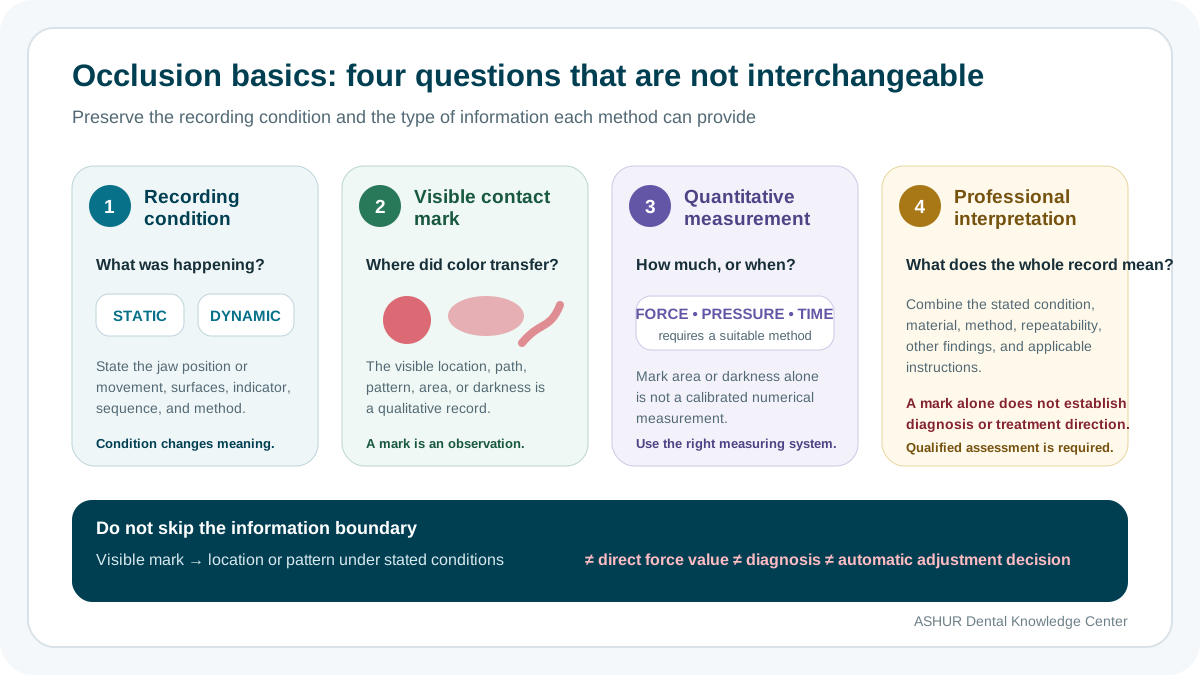
An occlusal contact is a location where opposing tooth surfaces meet under a stated jaw position or movement. Static contact refers to a contact relationship observed without relative movement. Dynamic contact refers to a contact relationship observed while the mandible and opposing surfaces move. A visible articulating-paper mark can help record a contact location, but its size or darkness does not by itself measure force or establish a diagnosis.
Five terms to keep separate
| Term | Plain-language meaning | Important limit |
|---|---|---|
| Occlusion | The relationship between opposing tooth surfaces in a stated jaw position. | The word alone does not specify one ideal position or a treatment goal. |
| Occlusal contact | A location or area where opposing surfaces meet under the stated condition. | A contact location is not automatically a numerical force value. |
| Static contact | A contact relationship observed without relative mandibular movement. | The exact recording position and method still need to be stated. |
| Dynamic contact | A contact relationship observed while contacted surfaces move relative to each other. | A movement mark can include a path; it is not the same record as a static mark. |
| Occlusal force | Loading applied between opposing teeth. | Paper-mark area or darkness alone is not a calibrated force measurement. |
Why distinguish static and dynamic records?
The recording condition changes what a mark represents. A closing contact record and a movement record should not be merged as though they were the same observation. A useful record states whether the surfaces were stationary or moving, the indicator used, the jaw condition, and the comparison method.
Why observe contact location?
Contact location can support description, documentation, comparison, and communication. The value comes from preserving the conditions and limits of the observation. Location alone does not identify how much force was present, whether the contact caused symptoms, or whether a surface should be adjusted.
Contact location and force are different
A contact mark answers a qualitative location question: where did visible transfer appear under the stated conditions? Force is a quantitative loading concept that requires an appropriate measurement method. Published evidence cautions against using paper-mark area alone as a proxy for force percentage.
Beginner vocabulary
- Contact mark
- A visible record produced by a marking material at a contact location.
- Qualitative observation
- A description of location, pattern, or appearance rather than a direct numerical measurement.
- Recording condition
- The position or movement, indicator, surface condition, technique, and sequence attached to an observation.
- Reference method
- The method used to compare or confirm what a visible record represents.
- Articulation
- A term used for contact relationships involving movement; usage should follow the professional context in which it appears.
Limits of this guide
This page provides terminology, not a clinical examination, diagnosis, treatment plan, adjustment protocol, or ASHUR product-performance claim. Terms can have context-specific professional usage, so clinical decisions must rely on qualified assessment and applicable instructions.
References
These sources support general terminology and the limited educational statements above. They do not verify ASHUR product performance, safety, regulatory status, intended use, or clinical outcomes.