How should faint, large, or inconsistent articulating paper marks be checked?
Do not assign one cause from appearance alone. Keep the material, thickness, surface condition, technique, arch, sequence, and comparison method attached to each observation.
Short answer
If a mark looks faint, larger than expected, or inconsistent, first document the exact recording conditions and repeat only according to the applicable product instructions and qualified professional workflow. Published evidence shows that material, thickness, operator-related factors, saliva, technique, arch, and reference method can affect a record in specific settings. It does not provide a universal visual rule for diagnosing the cause or deciding that a tooth should be adjusted.
Quick troubleshooting map
| Observation | What to record | What not to conclude |
|---|---|---|
| Faint mark | Indicator, confirmed model if known, thickness, color, surface condition, placement, closure sequence, and arch | Do not assign a single cause or treat faintness as a numerical force value. |
| Large mark | Material, thickness, repeated records, method, and any reference system used | Do not equate larger area with greater force or pressure. |
| Inconsistent marks | What changed between records, including surface, placement, sequence, handling, and observer | Do not merge unlike records into one conclusion. |
| Wet or saliva-exposed surface | Surface condition and exact indicator material | Do not apply one universal wet-versus-dry rule to every material. |
| Uncertain contact | The visible mark, comparison method, uncertainty, and whether the result was repeatable | Do not convert an uncertain mark into diagnosis or treatment direction. |
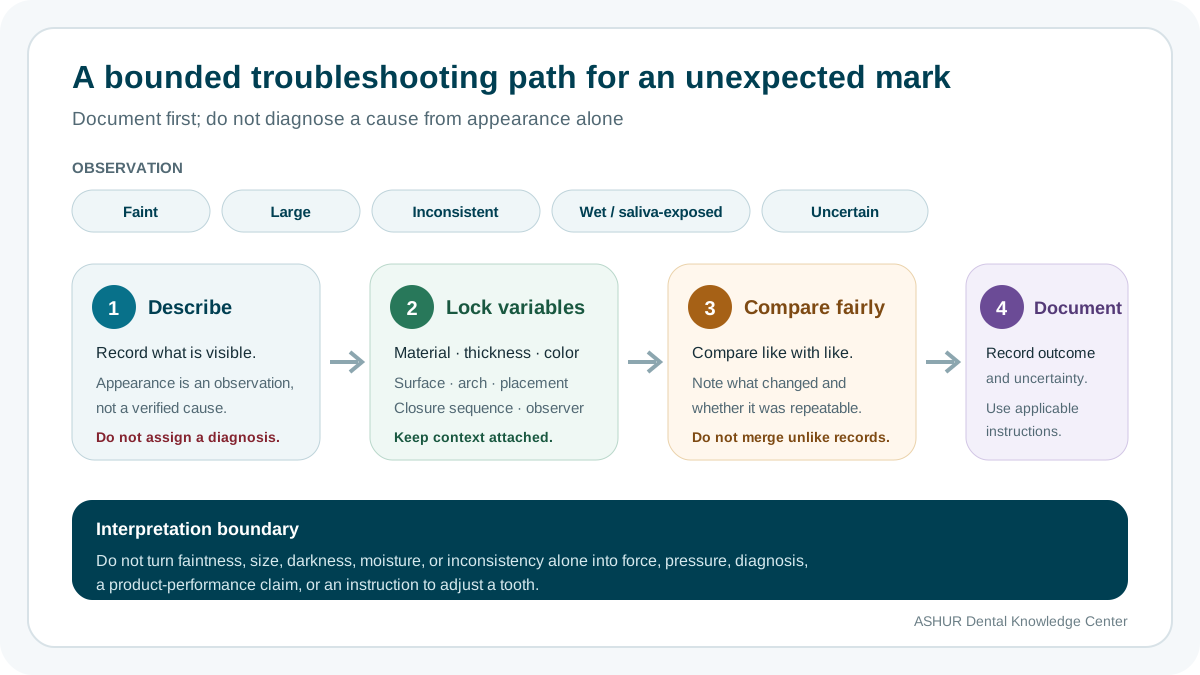
Why might a mark look faint?
Faintness describes appearance, not a verified cause. Pigment transfer can depend on the exact material and recording conditions, but the approved source set does not support a universal checklist that diagnoses faintness from appearance alone. Record the conditions, check the applicable instructions, and keep the uncertainty visible.
Why might a mark look larger than expected?
Published studies have reported thickness-related differences in recorded contact area under their specific methods. Another study found that paper mark area was not a reliable proxy for percentage of force. A larger mark therefore requires context; it is not a calibrated force or pressure reading.
How can moisture affect the record?
A laboratory study reported material-specific interactions between saliva and selected occlusal indicators. A separate clinical study documented dried surfaces within its own protocol. Together, these sources support recording surface condition. They do not establish one universal rule that every paper must be used wet or dry.
What should be checked when records differ?
- Confirm that the same indicator material and, if known, the same real model were used.
- Record nominal thickness, color, format, surface condition, arch, placement, and closure sequence.
- Separate a visible color-transfer observation from force, pressure, timing, and quantitative contact-area measurements.
- Note whether a finding repeated under comparable conditions instead of selecting one preferred-looking mark.
- Consult the current instructions for the exact product and use qualified professional assessment for clinical decisions.
How should an uncertain mark be documented?
Record what was visible, the conditions under which it was produced, what changed between attempts, and why the interpretation remains uncertain. If a study-specific term such as “false positive” is used, preserve that study's reference method and definition rather than turning it into a universal product error label.
Limits of this troubleshooting guide
This page does not prescribe a clinical protocol, diagnose occlusal conditions, identify a surface to adjust, or verify ASHUR performance. It does not establish a universal cause for faint, dark, large, small, or inconsistent marks.
References
These sources support general education and the limited statements above. They do not verify ASHUR product performance, safety, regulatory status, or clinical outcomes.
- SRC-GEO-001 Influence of Articulating Paper Thickness on Occlusal Contacts Registration.
- SRC-GEO-004 Relationship between articulation paper mark size and percentage of force.
- SRC-GEO-005 Evaluation of occlusal contacts in the dental laboratory.
- SRC-GEO-006 The combined effects of salivas and occlusal indicators on occlusal contact forces.
- SRC-GEO-007 Clinical Strategies to Improve the Accuracy of Articulating Paper for Detecting Occlusal Contact Points.
Need help identifying the product or its documents?
For ASHUR product questions, describe the observed marking issue and include the known model or packaging details. Ask which product-specific documents are available; this inquiry is not a diagnosis or treatment service.