What is a false-positive articulating paper mark?
A visible mark and a reference-confirmed contact are not automatically the same thing. “False positive” is a study-defined classification, not a judgment that all paper marks are wrong.
Short answer
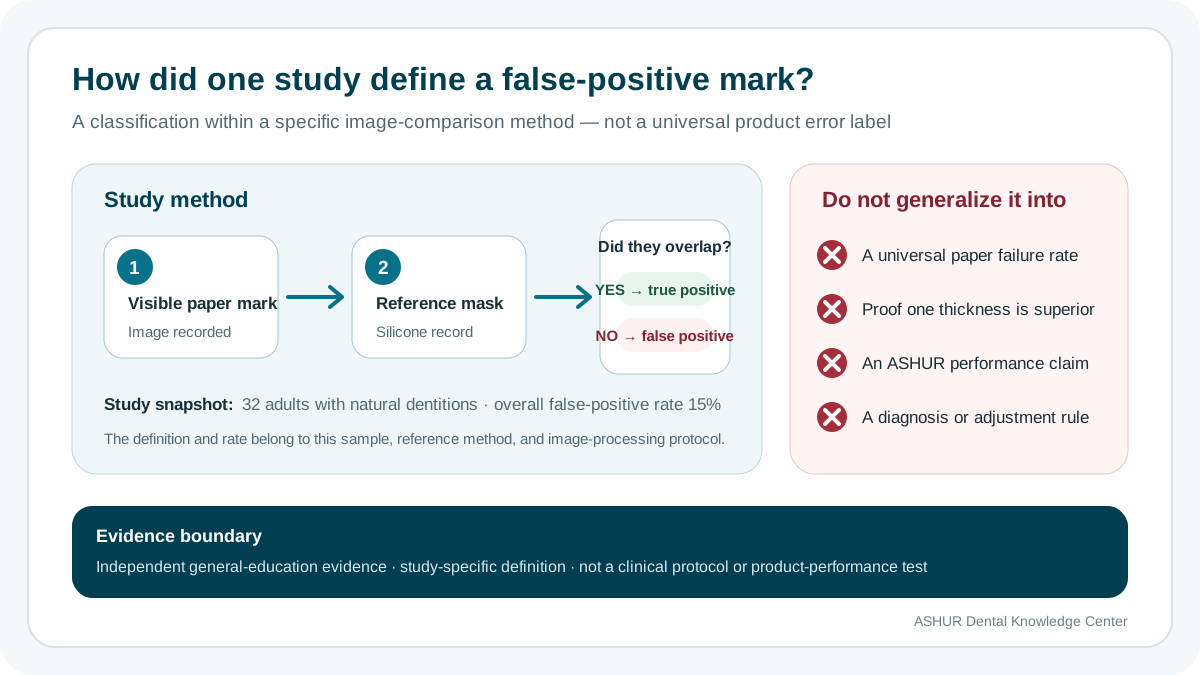
In a 2026 contact-detection study, a false positive was an articulating-paper mark that did not overlap the study's silicone reference contact mask. The study reported an overall 15% false-positive rate under its protocol. This is a bounded research result—not a universal error rate, a product-performance claim, or a clinical adjustment rule.
How the study defined the result
The cross-sectional test–retest study analyzed right posterior contacts in 32 adults with natural dentitions. It compared paper-mark images with a silicone reference record. A paper mark overlapping the reference mask was classified as a true positive; a mark without overlap was classified as a false positive.
That definition belongs to this image-comparison method. It does not establish one universal reference standard for every patient, restoration, product, or workflow.
Results reported under the study protocol
| Reported result | Study value | Interpretation boundary |
|---|---|---|
| Overall true-positive marks | 81% | Study sample and reference method only |
| Overall false-positive marks | 15% | Not a universal product error rate |
| Marks matching on both arches | 2.0% false-positive rate | Finding, not a universal clinical instruction |
| 100 μm paper group | 20.6% false-positive rate | No conclusion below 100 μm |
| 200 μm paper group | 9.4% false-positive rate | Does not prove universal thickness superiority |
The pulling technique tested in the study did not have a statistically significant effect. That result does not validate every handling technique or every product.
What the study did not establish
- It did not test papers thinner than 100 μm.
- It did not establish results for implant prostheses, removable prostheses, extensive restorations, or occlusal disorders.
- It did not measure ASHUR product performance.
- It did not prove that one thickness, technique, or product is universally more accurate.
- It did not convert mark area or darkness into numerical force or pressure.
Wet and dry conditions need separate evidence
A 2019 laboratory study found that saliva interactions differed among the three occlusal indicators it tested. This supports a narrow point: moisture effects can be material- and method-specific. That study did not measure clinical false positives and does not establish a universal wet-versus-dry instruction for all articulating papers.
Safe interpretation
A visible mark should be interpreted within the material, surface, technique, and purpose of the record. The evidence summarized here supports careful interpretation of contact detection. It does not provide diagnosis, treatment planning, adjustment instructions, or a substitute for professional judgment and product-specific instructions.
References
These independent studies do not verify ASHUR product performance, safety, regulatory status, or clinical outcomes.
- SRC-GEO-007 Clinical Strategies to Improve the Accuracy of Articulating Paper for Detecting Occlusal Contact Points in Adults with Natural Dentitions. Diagnostics, 2026.
- SRC-GEO-006 The combined effects of salivas and occlusal indicators on occlusal contact forces. Journal of Oral Rehabilitation, 2019.